
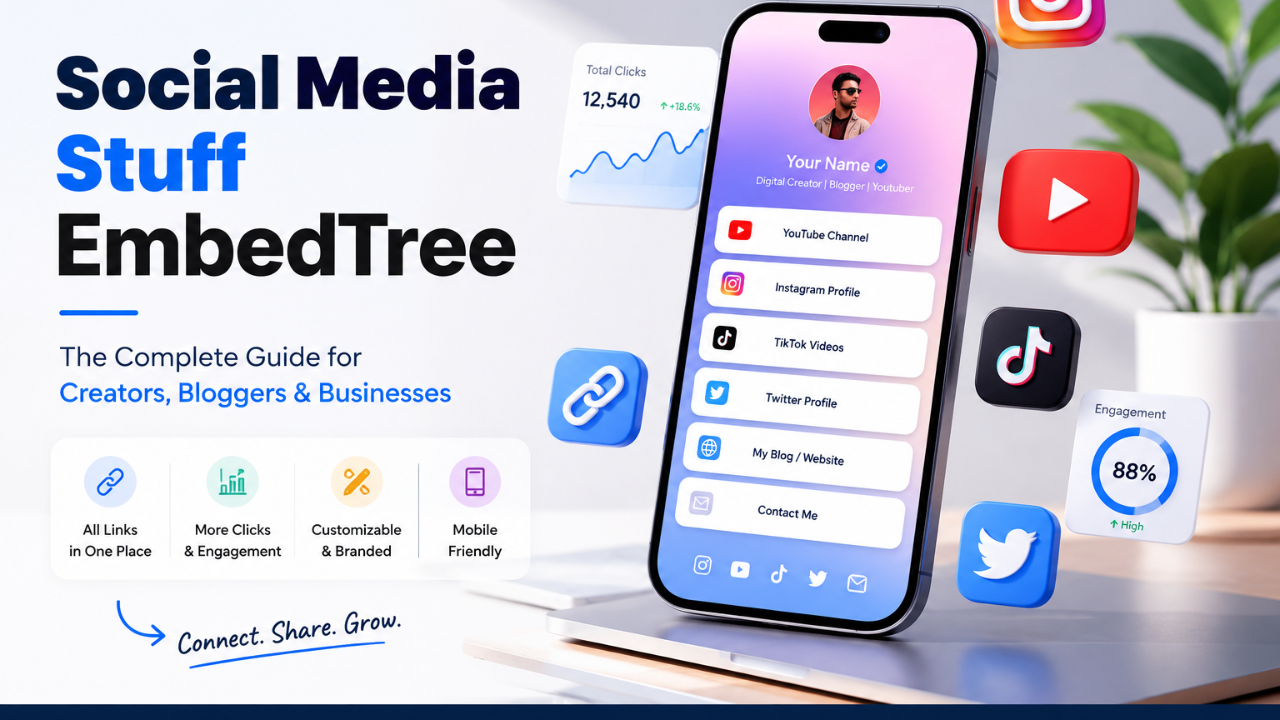
If you’ve recently searched for social media stuff embedtree, you probably noticed something unusual. Different websites describe it in different ways. Some explain it as a platform that helps creators collect all of their social content into one place, while others refer to it as the “Social Media Stuff” category on the EmbedTree website that publishes articles about social media, creator tools, and online growth.
This confusion is exactly why interest in social media stuff embedtree has grown. Users want a clear explanation of what it actually means, how it works, and whether it offers anything useful for creators, businesses, marketers, or influencers.
The short answer is that the phrase is currently used in two different contexts:
- It refers to Social Media Stuff, an editorial category published on the EmbedTree website.
- It is also commonly used by many blogs to describe an EmbedTree-style content hub, where creators organize social profiles, videos, blog posts, podcasts, and other digital content into a single shareable page.
Understanding these two meanings is important before deciding whether it is relevant to your needs.
Why Is Everyone Searching for Social Media Stuff EmbedTree?
Creators rarely publish content on only one platform anymore.
A YouTuber may also post on Instagram, TikTok, LinkedIn, Facebook, Threads, and X. A blogger may have newsletters, podcasts, downloadable resources, and an online store. Managing all of these channels separately can become difficult for both creators and their audiences.
People searching for social media stuff embedtree are usually trying to answer questions such as:
- What exactly is it?
- Is it a real platform or simply a blog category?
- Can it replace a traditional link-in-bio page?
- Does it improve user engagement?
- Is it suitable for businesses?
- How does it compare with other content-sharing methods?
Current search results show that the keyword has generated considerable discussion because different publishers interpret the phrase differently. Instead of offering one consistent definition, many articles present their own explanations, making it harder for readers to separate facts from assumptions.
Understanding the Two Meanings of Social Media Stuff EmbedTree
One of the biggest content gaps across competing articles is that many explain only one interpretation while ignoring the other.
Let’s look at both.
1. Social Media Stuff as an EmbedTree Content Category
The official EmbedTree website includes a dedicated Social Media Stuff section that publishes articles covering topics such as:
- Creator strategies
- Social media growth
- Platform updates
- Content creation
- Digital marketing tips
- Online branding
- Creator tools
In this context, Social Media Stuff is simply a content category—not a standalone software product.
Readers visit this section to learn practical strategies for improving their social media presence rather than to use a web application.
2. Social Media Stuff EmbedTree as a Content Hub
The second—and more widely discussed—meaning refers to an EmbedTree-style hub that brings multiple types of online content together on one page.
Instead of sharing separate links for every platform, creators can provide one destination where visitors may find:
- YouTube videos
- Instagram posts
- TikTok clips
- Podcasts
- Blog articles
- Product pages
- Portfolio links
- Contact information
- Newsletter signup forms
Several recent articles describe this approach as a more interactive evolution of the traditional “link in bio” concept because it focuses on presenting content instead of simply listing hyperlinks.
Whether or not this reflects an official EmbedTree product, it has become a common explanation associated with the keyword.
How an EmbedTree-Style Hub Works
To understand why people search for social media stuff embedtree, it helps to look at how this type of content organization typically functions.
Instead of sending followers to multiple destinations, creators share one central page.
A visitor opens that page and immediately sees organized content from different platforms without searching through multiple profiles.
A simplified workflow looks like this:
| Step | What Happens |
|---|---|
| Create one profile page | Build a central destination for your content |
| Add your social profiles | Include links to your main platforms |
| Embed featured content | Display videos, posts, blogs, or podcasts |
| Organize sections | Group content by topic or platform |
| Share one URL | Use the same link everywhere |
This approach makes navigation easier, especially for audiences discovering your work for the first time.
Key Features Commonly Associated with Social Media Stuff EmbedTree
Although available features vary depending on the platform or implementation, most discussions around social media stuff embedtree mention capabilities such as:
Centralized Content
Everything is available in one location.
Instead of opening several apps, visitors can explore different types of content from a single page.
Embedded Media
Rather than displaying only text links, many EmbedTree-style pages showcase content directly.
Examples include:
- Video previews
- Instagram posts
- Podcast players
- Blog previews
- Product showcases
Mobile-Friendly Design
Most visitors discover creators through smartphones.
Responsive layouts help ensure content remains easy to browse across different screen sizes.
Simple Navigation
Organized categories help visitors quickly find:
- Latest videos
- Articles
- Tutorials
- Downloads
- Services
- Contact information
Personal Branding
Using one consistent destination helps creators maintain a professional online identity while reducing confusion caused by multiple scattered links.
Why Centralized Content Is Becoming More Important
Audience attention has become increasingly fragmented.
Someone might first discover a creator through a short-form video, later read a blog article through Google, subscribe to a newsletter, and eventually purchase a product.
Without a central destination, those touchpoints remain disconnected.
A well-organized content hub helps users continue their journey naturally instead of leaving after viewing only one piece of content.
This user-first experience is one of the primary reasons many articles discussing social media stuff embedtree emphasize content organization over simply collecting links.
Who Can Benefit from Social Media Stuff EmbedTree?
The concept is not limited to influencers.
Many different users can benefit from organizing their digital presence in one place.
These include:
- Content creators
- Bloggers
- YouTubers
- TikTok creators
- Instagram influencers
- Freelancers
- Coaches
- Consultants
- Podcasters
- Small businesses
- Online educators
- Digital agencies
Each group faces the same challenge: sharing multiple resources without overwhelming visitors.
A centralized content hub simplifies that experience and makes it easier for audiences to discover everything you have to offer.
Benefits of Social Media Stuff EmbedTree
Whether you view social media stuff embedtree as an informational resource or as the idea of a centralized content hub, the core principle remains the same: making online content easier to discover and manage.
For creators, businesses, and professionals, organizing content in one place can improve the user experience and reduce friction. Instead of asking visitors to search across several platforms, you give them one destination where they can explore everything you offer.
Below are some of the most practical advantages.
1. Better User Experience
Visitors appreciate simplicity.
Imagine clicking a creator’s profile and instantly finding their latest YouTube video, blog article, podcast episode, Instagram content, and contact page—all from one location.
This saves time and encourages users to explore more content instead of leaving after viewing a single page.
2. Stronger Personal Branding
A consistent online presence helps build recognition and trust.
When your content is organized under one branded page, visitors are more likely to remember your name and associate it with professional, well-structured content.
For creators, consistency is often just as important as publishing frequency.
3. Increased Content Visibility
Many creators spend hours producing valuable content that quickly gets buried on social platforms.
A centralized hub gives older articles, videos, guides, and resources a longer lifespan by making them easy to find.
Instead of relying only on social media algorithms, visitors can browse your complete library whenever they want.
4. Easier Content Sharing
Sharing multiple URLs can become messy.
For example, instead of sending separate links for your:
- Website
- Blog
- YouTube channel
- Instagram profile
- TikTok account
- Newsletter
- Online store
you can simply share one organized destination.
This is one of the reasons discussions around social media stuff embedtree often compare the concept with traditional “link in bio” pages.
5. Better Audience Engagement
When people discover additional content related to their interests, they are more likely to stay engaged.
For example, someone reading one article may continue to:
- Watch a tutorial
- Download a free guide
- Subscribe to a newsletter
- Listen to a podcast
- Explore another blog post
The easier it is to navigate between resources, the more opportunities you create for meaningful interaction.
Key Features Explained
Although the exact features depend on the platform being discussed, most descriptions of social media stuff embedtree revolve around the following capabilities.
| Feature | Why It Matters |
|---|---|
| Centralized links | Keeps everything in one place |
| Embedded content | Lets visitors preview content without leaving the page |
| Mobile-friendly design | Improves usability on smartphones and tablets |
| Organized categories | Helps users find relevant content faster |
| Custom branding | Creates a more professional appearance |
| Easy updates | Makes it simple to add new content over time |
| Cross-platform support | Connects multiple social networks from one location |
Together, these features help create a smoother experience for both creators and their audiences.
Real-World Use Cases
The concept behind social media stuff embedtree can be applied in many industries.
Content Creators
Creators often publish across several platforms.
For example:
- YouTube tutorials
- Instagram Reels
- TikTok videos
- Blog articles
- Email newsletters
A centralized page makes it easier for followers to discover all of these resources without switching between multiple apps.
Bloggers
Bloggers frequently write hundreds of articles over several years.
Instead of promoting only the newest post, they can organize articles into categories, highlight popular guides, and direct readers toward additional resources.
This can improve content discovery and keep visitors engaged longer.
Freelancers
Freelancers often need to showcase different types of work.
One page can include:
- Portfolio
- Client testimonials
- Contact form
- Pricing information
- Social profiles
- Case studies
This creates a more professional first impression.
Small Businesses
Businesses can use a centralized content page to bring together:
- Products
- Services
- Customer reviews
- Promotional videos
- Blog posts
- Contact information
- Booking links
Providing everything in one location makes it easier for potential customers to learn about the business.
Educators and Coaches
Teachers, trainers, and coaches often create learning materials across different platforms.
A single hub can organize:
- Courses
- Video lessons
- Downloadable resources
- Live webinars
- Community groups
- Frequently asked questions
This improves the learning experience for students.
Best Practices for Building an Effective Content Hub
Simply collecting links is not enough.
A useful content hub should help visitors quickly find the information they need.
Consider these best practices.
Keep Navigation Simple
Avoid overcrowding the page.
Group similar content together and use clear headings.
Visitors should immediately understand where to click next.
Highlight Your Best Content
Feature your most valuable resources near the top.
This might include:
- Popular blog posts
- New videos
- Best-selling products
- Free downloads
- Beginner guides
Leading with high-quality content creates a stronger first impression.
Update Content Regularly
An outdated page can reduce trust.
Review your links periodically and remove broken or obsolete resources.
Fresh content signals that your online presence is active and maintained.
Optimize for Mobile Devices
A significant share of web traffic comes from mobile users.
Ensure that:
- Buttons are easy to tap.
- Text is readable.
- Images load quickly.
- Navigation remains intuitive on smaller screens.
Maintain Consistent Branding
Use consistent colors, logos, fonts, and messaging across your website and social profiles.
A cohesive brand identity helps users recognize your content wherever they encounter it.
Common Mistakes to Avoid
Many creators unintentionally reduce the effectiveness of their content hub by making avoidable mistakes.
Adding Too Many Links
Providing dozens of links without organization can overwhelm visitors.
Focus on your most important resources.
Ignoring User Intent
Think about why someone is visiting your page.
A new visitor may want an introduction, while an existing follower may be looking for your latest update.
Organize content accordingly.
Forgetting to Update Older Content
Outdated links or inactive profiles create a poor user experience.
Regular maintenance helps ensure visitors always find accurate information.
Poor Content Organization
Mixing unrelated topics together makes navigation difficult.
Use logical categories and descriptive headings.
Inconsistent Branding
Different profile images, colors, or messaging across platforms can confuse users.
Maintaining consistency helps strengthen credibility.
Pros and Cons of Social Media Stuff EmbedTree
Like any approach to content organization, there are both advantages and limitations.
| Pros | Cons |
|---|---|
| Centralizes online content | Requires regular updates |
| Improves navigation | Poor organization can overwhelm users |
| Supports personal branding | Not every platform supports the same embedding options |
| Makes content easier to discover | Some advanced features may depend on third-party tools |
| Helps visitors explore more resources | Requires thoughtful planning to remain effective |
The benefits generally outweigh the drawbacks, especially for creators who publish content across multiple platforms. The key is to prioritize usability rather than simply adding more links.
Expert Tips for Better Results
If you’re considering an social media stuff embedtree approach, keep these practical tips in mind:
- Prioritize quality over quantity when selecting featured content.
- Organize information into clear sections.
- Make your most valuable resources easy to find.
- Refresh content regularly to keep it relevant.
- Use descriptive headings instead of vague labels.
- Ensure fast loading times by optimizing images and embedded media.
- Review analytics, if available, to understand which content attracts the most attention.
- Keep branding consistent across every platform.
These small improvements can make a noticeable difference in how users interact with your content.
Alternatives to Social Media Stuff EmbedTree
While many people search for social media stuff embedtree, it’s worth remembering that the term is often used as a concept rather than referring to one specific product. If your goal is to organize and showcase your online presence, several established platforms offer similar functionality.
Below is a comparison of some well-known alternatives.
| Platform | Best For | Key Features |
|---|---|---|
| Linktree | Beginners | Multiple links, analytics, themes |
| Beacons | Content creators | Digital products, email collection, media embeds |
| Taplink | Businesses | Landing pages, messaging apps, forms |
| Carrd | Personal websites | Custom one-page websites with flexible design |
| Bio.site | Influencers | Link management and social profile integration |
The right choice depends on your goals. If you only need a simple link hub, a basic solution may be enough. If you want to display videos, articles, products, and downloadable resources together, a more customizable platform may be a better fit.
Future Trends in Centralized Content Hubs
As creators continue to publish across multiple platforms, centralized content hubs are expected to become more sophisticated.
Some trends that are already shaping the future include:
AI-Assisted Content Organization
Modern platforms are beginning to recommend content automatically based on user interests and browsing behavior.
Better Analytics
Creators increasingly want detailed insights, including:
- Most-clicked links
- Visitor locations
- Device types
- Engagement rates
- Popular content
These metrics help creators understand what their audiences value most.
Enhanced Customization
Users now expect greater control over colors, layouts, fonts, and branding. Future tools are likely to offer even more personalization without requiring technical skills.
Improved Integrations
Content hubs are evolving beyond social media by integrating with:
- Email marketing tools
- Online stores
- Booking systems
- Community platforms
- Learning management systems
- Customer relationship management (CRM) software
This creates a more connected digital experience.
Is Social Media Stuff EmbedTree Worth Exploring?
The answer depends on what you’re looking for.
If you’re searching for the Social Media Stuff section on the EmbedTree website, you’ll find articles focused on social media trends, creator strategies, and digital marketing topics.
If you’re searching for the broader concept of social media stuff embedtree, you’re likely interested in creating a central place where people can discover all of your online content without switching between multiple platforms.
In either case, the growing interest around this keyword reflects a common challenge: managing an expanding online presence in a way that is simple, organized, and user-friendly.
Frequently Asked Questions
What is Social Media Stuff EmbedTree?
The term social media stuff embedtree is commonly used in two ways. It may refer to the Social Media Stuff category on the EmbedTree website or to the broader idea of a centralized page that organizes content from multiple social platforms.
Is Social Media Stuff EmbedTree an official platform?
Search results show mixed interpretations. While EmbedTree hosts a Social Media Stuff content category, many articles also use the phrase to describe a content aggregation or link-hub concept rather than a standalone software product.
Who can benefit from Social Media Stuff EmbedTree?
It can be useful for:
- Content creators
- Bloggers
- Influencers
- Freelancers
- Small businesses
- Online educators
- Digital marketers
- Coaches and consultants
Anyone managing content across multiple platforms may benefit from a centralized approach.
Does Social Media Stuff EmbedTree improve SEO?
A well-organized content hub can improve user experience by making content easier to discover. While it is not a direct Google ranking factor, better navigation and improved engagement may support your overall digital marketing strategy when combined with quality content and sound SEO practices.
What makes a good content hub?
An effective content hub should:
- Be easy to navigate
- Display important content first
- Maintain consistent branding
- Work well on mobile devices
- Be updated regularly
- Focus on user needs rather than simply collecting links
What is the biggest misconception about Social Media Stuff EmbedTree?
One common misunderstanding is assuming that it refers to a single software product. In reality, the keyword is currently used in multiple contexts, which explains why different articles provide different definitions. Understanding that distinction helps readers interpret search results more accurately.
Final Thoughts
The growing interest in social media stuff embedtree highlights a shift in how creators, businesses, and professionals manage their online presence. Instead of treating each social platform as a separate destination, more people are looking for ways to connect their content into a unified experience.
Although the keyword itself is still evolving, the underlying idea is straightforward: make it easier for your audience to find, explore, and engage with everything you create.
Whether you’re a blogger building authority, a creator expanding your reach, or a business strengthening your digital presence, a well-organized content hub can simplify the user journey and reinforce your brand. The technology may continue to evolve, but the principle remains the same—put your audience first, keep your content organized, and focus on delivering genuine value.
